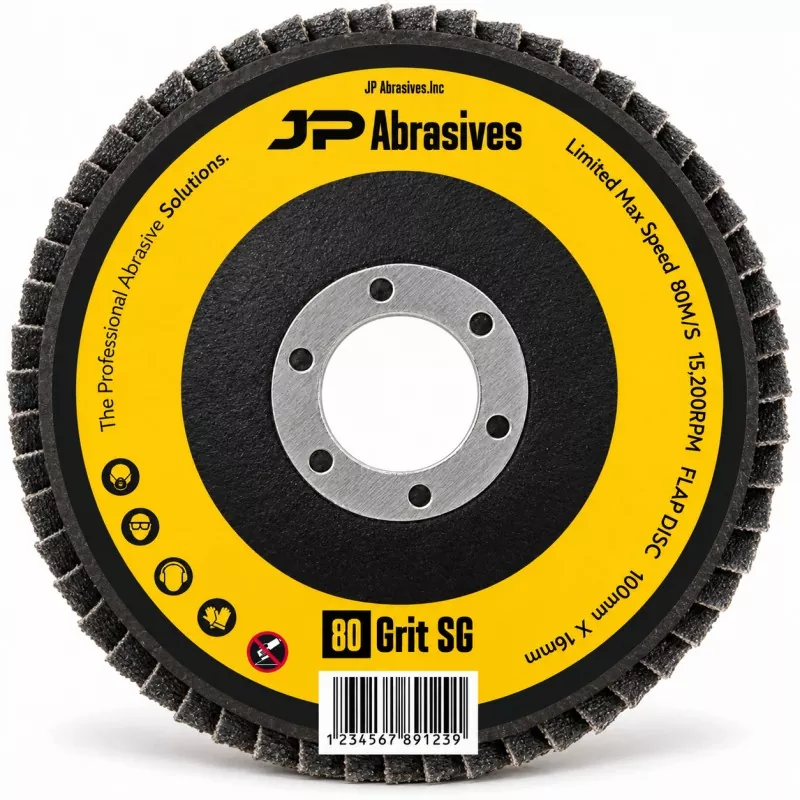
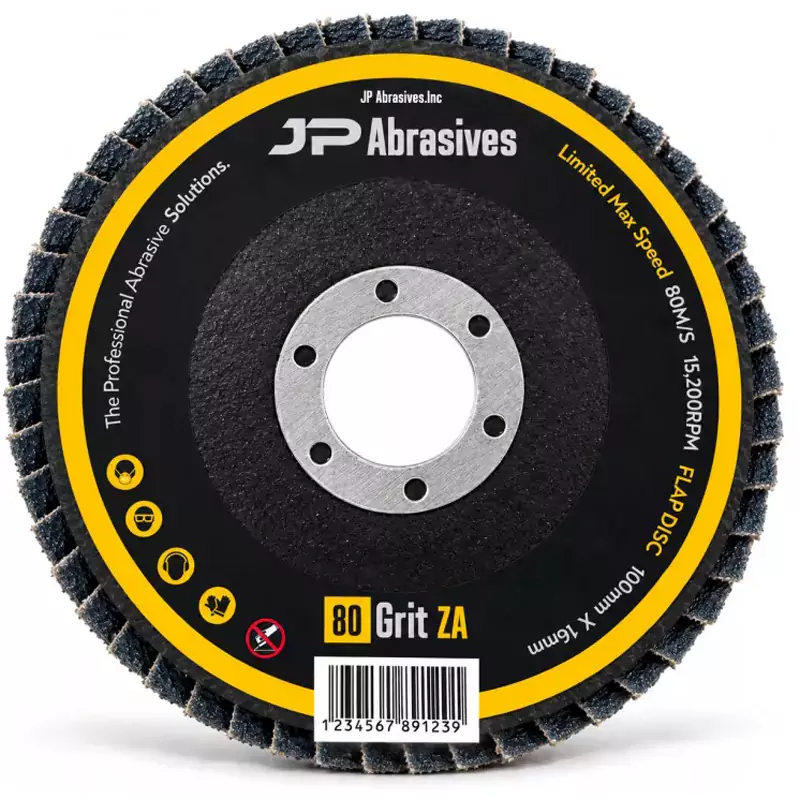
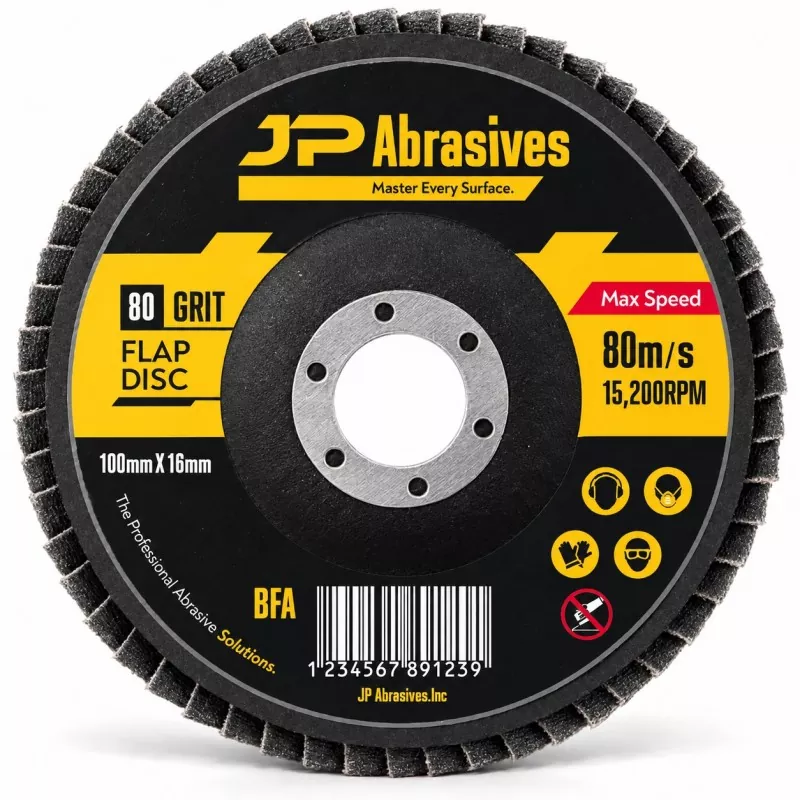
Ceramic Flap Disc
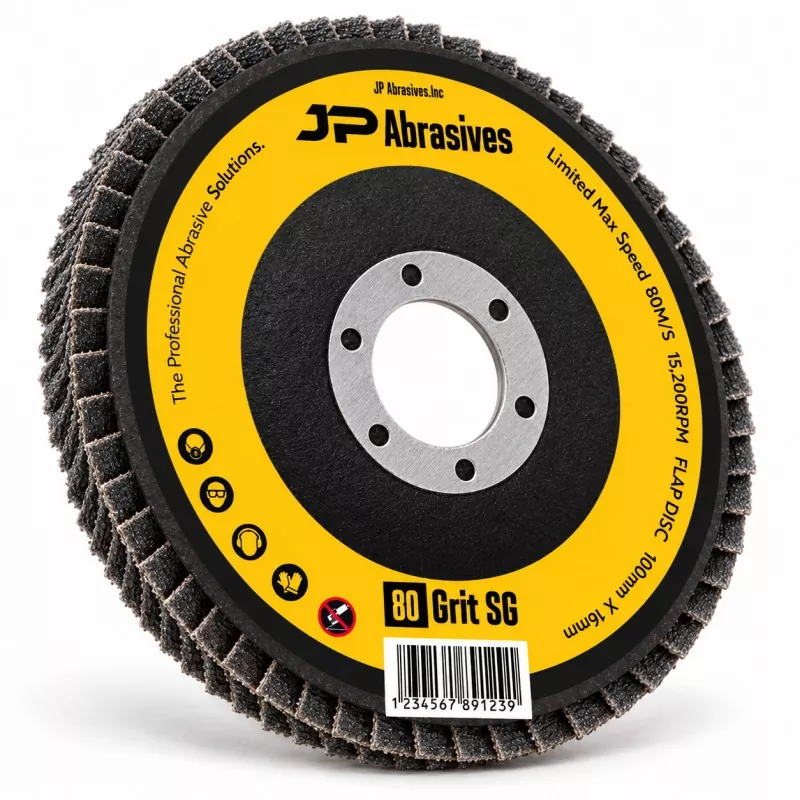
The C-Series Ceramic Flap Disc produced by JP Abrasives suppliers belongs to high-end industrial grinding consumables. It is equipped with a microcrystalline ceramic alumina abrasive system and is an efficient grinding tool for high-capacity metal processing scenarios.
Unlike conventional abrasives that rely on continuous pressure to maintain cutting, this C-Series Ceramic Flap Disc from the JP Abrasives factory supplies is designed to rely on the micro-cracking of the abrasive particles to continuously expose new sharp edges. This ensures that the cutting force does not diminish over a long period of operation.
When grinding stainless steel, high-strength steel, and alloy materials, it can reduce the additional temperature rise caused by friction, avoiding problems such as overheating and discoloration of the workpiece surface and damage to the metallographic structure. It is suitable for incorporating the grinding process into production lines with production rhythm control, helping factories evaluate the selection of consumables and overall production efficiency together.
Product details
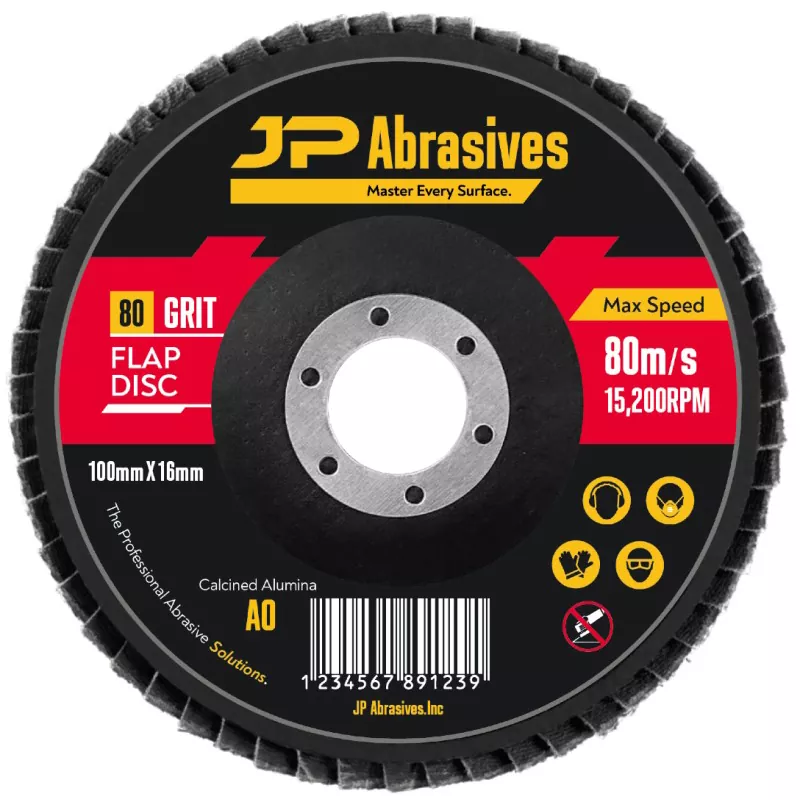
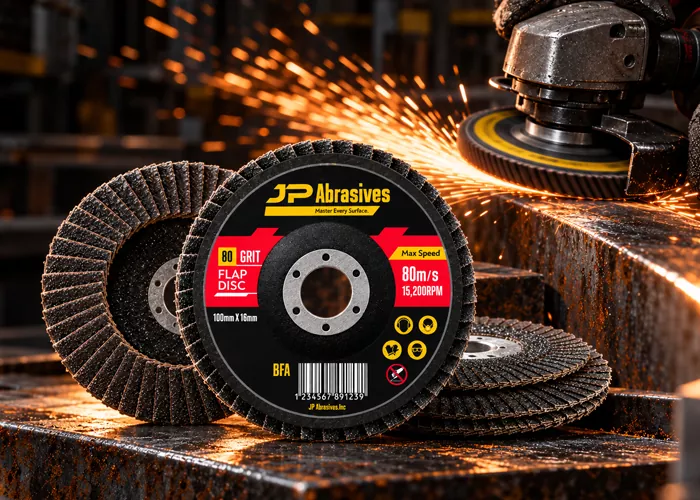
1. Adopting the T29 conical structure, it fits the conventional grinding angle of angle grinders, and has stable contact at weld seams, corners, and bevels.
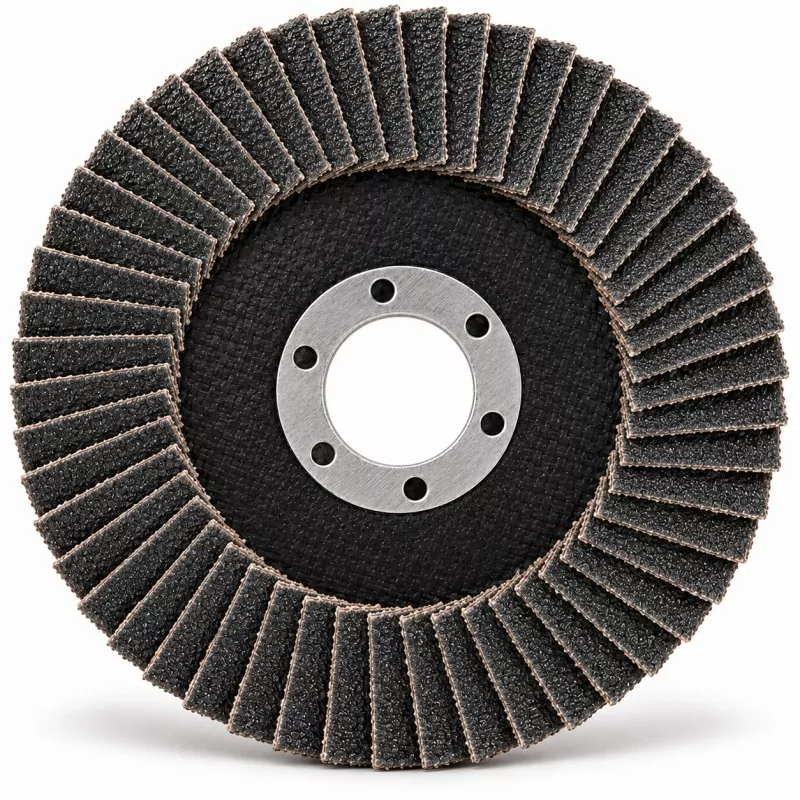
2. The arrangement of grinding disc sand teeth has been optimized, balancing the chip removal space and the grinding coverage area.
3. The bonding between the substrate and the sand teeth is firm, and sand teeth are unlikely to fall off under continuous high-pressure conditions.
4. The particle size covers the full range from P36 to P120, with the coarse particles mainly for large removal of excess material, and the fine particles for surface uniformity transition.
5. It supports various outer diameters and inner hole specifications to match mainstream angle grinders.
6. The product indicates the rated maximum rotational speed, comes with safety warning labels, and supports customized branding, packaging, and barcode solutions by distributors, facilitating the establishment of a graded consumable product line.
Why Ceramic Alumina?
Ceramic alumina is selected for demanding grinding because its microcrystalline abrasive structure is designed to renew cutting edges during use. Under suitable pressure, controlled micro-fracturing exposes fresh, sharp cutting points. This allows the abrasive to continue cutting rather than relying primarily on increasing operator pressure as the grain wears.
The practical objective is a more efficient cutting cycle: fracture, renew, cut and repeat. For industrial users, this supports a shift from treating abrasives only as consumables to evaluating them as productivity tools.
Maximum Material Removal per Minute
The defining performance objective of C-Series is maximum productive output. Heavy-duty grinding is not only about how much material a disc can remove during its total life; high-productivity manufacturing also requires measurement of how quickly that material is removed.
Material Removal Rate (MRR) should therefore be a primary performance indicator. In high-volume operations, even modest reductions in grinding time per component can accumulate into significant labor and capacity gains across multiple operators, shifts and production days.
Fast Cutting
A sharp abrasive cuts rather than merely rubs against the workpiece. The self-renewing behavior of ceramic alumina is intended to maintain an active cutting surface under suitable working conditions. For stainless steel, high-strength steel and demanding fabrication, this supports faster stock removal and reduces dependence on excessive pressure to compensate for dull abrasive grain.
C-Series should be evaluated using a combination of cut rate, disc life and grinding time. A disc that lasts longer but removes material slowly may not deliver the lowest total production cost.
Cooler Grinding Potential
Grinding always generates heat. The objective of cooler grinding is not to eliminate heat, but to reduce unnecessary friction and improve the proportion of grinding energy used for effective cutting. Maintaining sharper cutting points can help control avoidable heat input compared with a condition in which dull grain is primarily rubbing against the workpiece.
This is particularly relevant in stainless steel, high-strength steel and alloy applications where heat input, surface condition and downstream processing may be important. Actual grinding temperature depends on operating pressure, RPM, contact area, working angle, material and grinding duration.
Key Performance Advantages
1. High Material Removal Rate
Designed for applications where output per minute matters. C-Series targets efficient stock removal in professional production environments rather than minimum purchase price per disc.
2. Fast Cutting Performance
Ceramic abrasive technology supports active cutting under appropriate pressure, helping operators complete demanding grinding operations efficiently.
3. Continuous Self-Sharpening Action
Micro-fracturing of ceramic grain continually exposes fresh cutting points, supporting sustained cutting performance throughout the useful working cycle.
4. Controlled Heat Input
Efficient cutting can reduce unnecessary frictional heat. This is especially relevant when grinding stainless steel, high-strength steel and suitable alloy materials.
5. Reduced Disc-Change Potential
Where improved cutting efficiency and useful abrasive life reduce change frequency, manufacturers can recover operator time otherwise lost to stopping, removing and replacing discs.
6. Premium Manufacturing Productivity
The commercial objective is not simply a premium abrasive. It is lower total grinding cost through higher output, efficient labor use and better utilization of production time.
Primary Materials and Applications
Stainless Steel
C-Series is positioned for professional stainless-steel fabrication where weld removal, stock removal, edge grinding and production speed are important. Typical sectors include food-processing equipment, pharmaceutical equipment, chemical processing, piping, transportation, architectural metalwork and industrial fabrication.
High-Strength Steel
High-strength materials can increase grinding time and abrasive demand. C-Series is designed for applications where manufacturers need to improve removal efficiency rather than compensate for difficult materials by adding labor time.
Alloy Materials
Industrial equipment, automotive components, energy systems and advanced manufacturing may use a wide range of alloy grades. Product selection should be confirmed against the actual material grade, application, grinder, current abrasive and required removal rate.
Production Weld Grinding
For high-volume welding operations, the key metric is not only whether a weld can be removed, but how many welds can be processed per hour. C-Series is intended for production environments where weld grinding is a measurable part of cycle time.
Recommended Industrial Applications
· High-productivity stainless-steel grinding
· High-strength steel stock removal
· Alloy steel grinding where compatible with the selected specification
· Production weld grinding and weld blending
· Edge grinding and bevel preparation
· Heavy stock removal in continuous manufacturing
· Industrial fabrication with high labor and downtime costs
FAQ
1. How to choose between C-Series Ceramic Flap Disc and Z Series Zirconia Corundum Disc?
The Z Series focuses on powerful coarse grinding for removal; the C Series prioritizes cutting efficiency per unit time and is suitable for high-value workpieces such as stainless steel and high-strength steel, as well as mass production lines with high labor costs.
2. Is ceramic abrasive grinding completely without heat generation?
It is impossible to achieve completely heat-free grinding. It reduces ineffective frictional heat through more efficient cutting and lowers the risk of the workpiece overheating and turning black. Continuous heavy pressure grinding still causes temperature rise.
3. Can it be directly used for daily grinding of ordinary low-carbon steel?
It can be used, but the cost performance is relatively low. The A Series Oxide Corundum Disc is preferred for regular grinding of ordinary carbon steel, and it helps control the cost of material procurement.
4. Is the T29 conical style suitable for flat surface grinding?
The T29 is more suitable for curved surfaces and corners such as weld seams, edges, and notches; for large-area flat surface grinding, the T27 flat style can be prioritized for assessment.
5. Can samples be provided for on-machine comparison with existing grinding discs?
Sample testing is supported. We can provide corresponding grit samples based on your workpiece material, equipment, and target cycle time, to compare the working time and single-piece output.
6. Does this series support OEM custom branding?
Yes, custom disc surface labels, packaging, and specification combinations are supported. This enables distributors to create high-end consumable product lines.
7. How can one determine if this disc is suitable for their production line?
It is recommended to calculate the single-piece processing cost by comprehensively considering the single-piece grinding time, the number of workpieces that can be processed per single disc, and the downtime for disc replacement. Instead of just comparing the single-piece price.
Send Inquiry
Contact Info
-
Address
China:No.263,Central Street,Dadian Town,Junan County,Linyi City,Shandong Province,China
-
Tel
-
Email